The Neighborhood Music Fair – For a New Music Culture Paradigm
Back in the day I would make my way to Carter Barron Amphitheatre, which sits adjacent to Rock Creek Park along Washington, D.C.'s 16th Street corridor also known as the “Gold Coast.” The Gold Coast is a stretch of real estate that became nationally renowned as the premier haven for the District’s African-American movers and shakers in politics, education and finance. This cozy little 5000-seat capacity amphitheater was rededicated to the Washington civic leader and project commissioner, Carter T. Barron on May 25, 1951, by then-president Truman. This venue, built in the late 40’s, eventually became a Chocolate City institution and a genuine gem during the 70s and early 80s.
The Carter Barron amphitheater is nestled into a wooded area, among a somewhat affluent but still working-class neighborhood just a stone’s throw from the busy traffic up and down 16th street. I once sat among its rows witnessing the professionalism and amazing musical expertise of artists such as Nancy Wilson, Roy Ayers, Chuck Mangione, Chick Corea, Angela Bofill, Patrice Rushen, Dave Valentine, Ashford & Simpson, and Jean Carn, among many other acts.
Sometimes the experience felt almost like a “live” concert version of WHUR's radio broadcast, the “Quiet Storm” initially brought to us by Melvin Lindsey who routinely started his broadcast with Smokey Robinson’s title track “Quiet Storm” or Scott Jarrett’s “The Image of You.” Back then, you might see recording artists performing the type of jazz and Afro-Cuban music broadcast from the Adam’s Morgan public radio station, WPFW.
Those audiences seem to come from all walks of life. You would see people-watching, mostly affable and engaging folk, excited for the music unfolding before them. For the most part I felt inspired, being among those knowing smiles of passerby’s who just knew we were all in for a musical treat. Late into the evening you might see folks draped in sweaters while blissfully listening to those fiery instrumental solos. Let’s hope that the National Park Service eventually gets around to rebuilding the Carter Barron, which has been closed since 2017.
Summer Fun at The Carter Barron
But perhaps we shouldn't wait for every concert experience to be provided by a large bureaucratic-challenged institution like the National Park Service or some promotion agency. What if today's recording artists could themselves network and organize to present “live” music, without all the hassles?
Your Own Venue!!
I began thinking about this after watching a video of Duke Ellington performing outdoors with a trio in a sculpture garden in the south of France. As I watched, I happened to catch a glimpse of my own backyard through the window. I thought: I could imagine Duke Ellington out there, playing in front of our neighbor's tall bamboo trees. Then another thought followed:
Why not create a small space like that sculpture garden and invite musicians to rehearse and perform there from time to time?
It doesn't have to be a sculpture garden. It could be your backyard, a community garden, a church, a neighborhood cultural center, or a small park.
Here’s an example. In my children’s book “The Notable Characters” I illustrated the protagonists performing in their neighborhood park called Poplar Park.
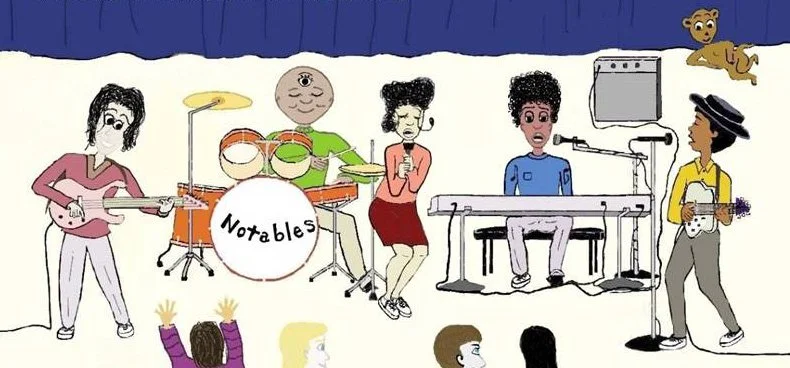
Illustrated by Lenny Rountree for “The Notable Characters” music literacy book © 2017 Washen Publishing
The important thing is the scale.
Small enough for people to know one another.
Small enough for musicians and listeners to actually talk.
Small enough for an artist to sell you a CD, provide you a link to download a song, or sell merchandise directly to you, because you are there in body, mind and spirit. You can connect whereas that would be unlikely in a larger venue.
So, after imagining Ellington swinging for the fences, I decided to create a small space for our family get-togethers by putting a performance area in our backyard. Because the area already lends itself to the shape of a tiny amphitheater, I began a DIY project to dig out a new patio from the incline and transfer that soil to an area where I wanted a stage to be. The work is currently underway now and it is labor of love, because I'm looking forward to hosting recitals there, “shedding,” performing, inviting guests—perhaps local a cappella vocal groups, classical musicians, and jazz groups.
I am still inspired and motivated by those Carter Barron experiences. Expanding upcoming events to include the neighboring community could be a challenge, but it would be a very small assembly of people in any case. But this is what I mean by “Neighborhood Music Fair.”
Old Paradigm
For musicians and listeners alike, a new way to experience the joy of music in a smaller universe can be no less inspiring than one trekking down to a big venue, after paying exorbitant ticket prices and having to pay even more money for parking and perhaps you end up waiting for the artist to hit the stage well after the start time printed on your ticket.
Many musicians and fans find “the game,” the music industry, exhausting, and disrespectful. In terms of the recording artists’ long-term financial benefit, health and well-being, the business of making, promoting, and selling music is perhaps worse than it has ever been in recent memory. When I look at some of my favorite musicians who are in their 70s and 80s and still touring, I sometimes wonder: Can they actually afford to retire? I suspect that for some of them, that grueling regimen is less about personal preference than necessity.
For decades, recording artists have rarely, if ever, received a fair share of the money generated by their work. The evolution and innovations of digital technology have enabled and streamlined the exploitation of recording artists, both young and old. As music is now easier than ever to distribute and consume, it has also deepened the disparity of income recording artists have with corporate power brokers.
Streaming has made virtually every song available at the touch of a button, yet the amount that an individual artist may ultimately receive from an individual stream can be remarkably small, less than one penny! Who gets the 99 percentage? 70 percent is already gone before the artist sees their cut per stream, at maximum: $0.015 cents from Tidal, $0.010 from Apple, $0.0064 maximum from Deezer and $0.005 maximum from Spotify.
Who should benefit most when people repeatedly listen to a piece of music—the company delivering the stream or the people who created the music?
But while these disparities are taking place, consumers still can easily create digital folders for downloaded song files they have purchased directly from their respected artists.
Did you know that song files can be imported to iTunes, stored in the cloud and piped into earbuds or speakers via Bluetooth? You don’t have to choose between a streaming service or directly downloading a song from an artist’s website; you can do both.
A Different Way of Giving and Receiving Music
The new paradigm of our music culture could be that recording artists organize to collectively demand reasonable percentages from streaming services. Individual artists could own their master recordings in perpetuity rather than surrendering that ownership to others.
And for gods-sake, if you love a musician's music, why not purchase it directly when that option is available? We sometimes hesitate to pay for a digital download, even though we wouldn't question paying for a physical product. No problem buying a handful of snack bars, but what, this artist you like is charging one dollar and some change for a product you will enjoy for years and years. Well, that payment for a digital download sure does give some people pause or worse yet, befuddles them. If you can follow the logic of this, then please clue me in.
Do they not realize that a digital download of a track does not age.
It is not digested and forgotten about, but instead, it is a new experience every time you listen, with no physical depreciation due to the passing of time, often revealing new aspects you missed before. Like Pat Metheny’s “Better Days Ahead” it’s joy on perennial repeat!
What’s a better thumbs up to an artist than purchasing their tracks from their website? When you do that, you help sustain them in their endeavors to create more music for you to enjoy.
I have probably spent thousands of dollars over the years supporting musicians I care about, because their songs, even after all this time, often make my day. Seeing them perform has inspired me again and again.
The Future Looks Slight
We often talk about changing the music industry as though the only solutions must come from record companies, streaming platforms, governments, or corporate promoters. But maybe some of the change can happen much closer to home on a smaller scale.
Artists can organize. I invite those of you who are independent recording artists to network with one another via the “Making Inds Meet” page at washentree.com. You can request to post your website there to expand your reach, however slight. Check it out by following the link below, then remember to click “For Friendly Indies.”
https://www.washentree.com/networking-artists-and-musicians
People have created places for “live” music performances, inviting established artists who have shown up! For all the extraordinary benefits of today’s technology, there is one thing it can’t beat, and that’s people in a small, quaint, relaxing venue enjoying the “front row” feel. Maybe one day a YouTube channel can post a consortium of “Neighborhood Music Fairs.” Would you attend? If the answer is yes, perhaps that is one of the first steps toward an alternative music culture – a new paradigm.
- Lenny Rountree
Here in Cheverly, I have broken ground for a stage to one day host a Neighborhood Music Fair. These are the “before” pictures. Wish me luck! Please leave a comment if you like.


For a broader understanding of how recording artists generally fair on today’s recording industry, please tap or click this recent post “The Economics of Music Labels”